AI vs Humans: Will Artificial Intelligence Replace Humans?
A balanced look at AI versus humans: what machines do better, what people do better, a side-by-side comparison, what it means for jobs and study, and why the realistic future is humans and AI working together rather than one replacing the other.
On this page
"Will AI replace humans?" is one of the most searched questions about technology, and most answers land at one of two extremes: either machines will make people redundant, or AI is overhyped and nothing will change. Both miss what is actually happening.
The realistic picture is more interesting and more useful. AI is very strong at a specific set of things and genuinely weak at others. Humans are the reverse. The future that most evidence points to is not humans versus AI, but humans working with AI, each covering for the other's blind spots. This article looks at where each side is strong, what that means for jobs and study, and how to prepare without panicking.
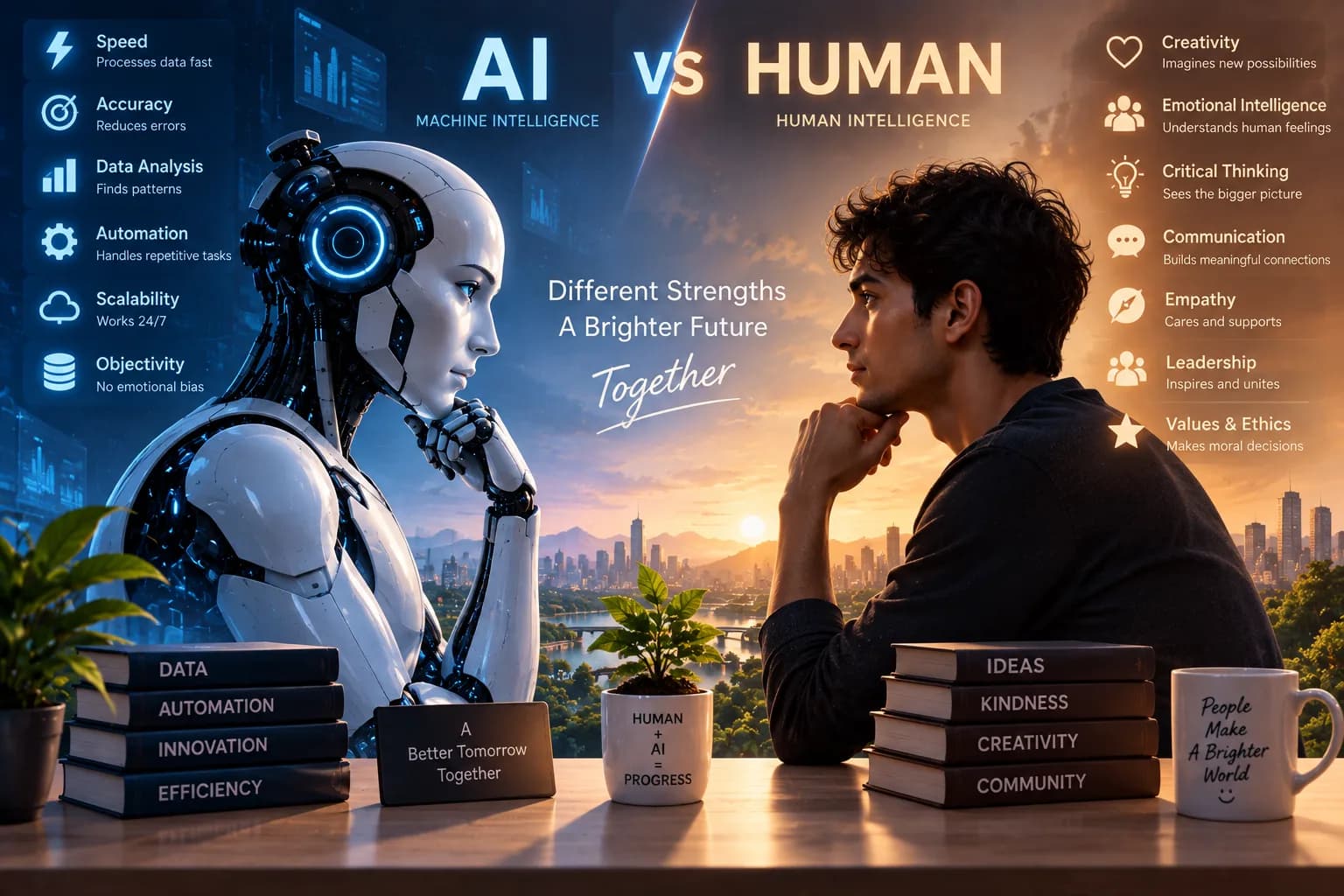
AI vs humans: the short version
AI is software that learns patterns from large amounts of data and uses them to predict, classify, or generate content. It has no body, no goals of its own, no feelings, and no understanding of the world beyond those patterns. Humans are general learners with bodies, emotions, social lives, values, and the ability to act with very little data and take responsibility for the result.
Because the two are built so differently, comparing them on a single scale of "intelligence" is misleading. It is more helpful to compare them task by task.
What AI can do better
- Speed on defined tasks. It reads, sorts, translates, and calculates far faster than any person.
- Consistency. It does not get tired, bored, or distracted, so it applies the same standard to item one and item ten thousand.
- Scale. One system can serve millions of requests at once.
- Pattern detection in large data. It spots faint signals across millions of rows that a person would never see.
- Recall. It can draw on a vast amount of text or examples instantly.
- Repetitive precision. For tasks like checking documents against a checklist, it rarely slips through simple boredom.
What humans can do better
- Understanding context. People read a room, a history, a culture, and unspoken intent.
- Judgement under uncertainty. We make sound calls with missing information and take responsibility for them.
- Genuine creativity with purpose. We decide what is worth making and why, not just remix what already exists.
- Emotional intelligence and empathy. We sense how someone feels and respond in a way that actually helps.
- Ethics and values. We weigh right and wrong, not just probable and improbable.
- Physical adaptability. We handle messy, changing physical environments with ease.
- Learning from very little. A person can learn a new task from one or two examples.
- Accountability. A human can be answerable for a decision in a way software cannot.
A closer look at the key abilities
Intelligence
AI intelligence is narrow and deep: superb inside its training, brittle outside it. Human intelligence is broad and flexible: we transfer knowledge from one area to a completely different one without retraining.
Creativity
AI can produce large volumes of drafts, variations, and combinations quickly, which is genuinely useful. But it works from what already exists. Humans set the direction, judge what is meaningful, break rules on purpose, and connect ideas across unrelated fields for reasons that matter to people.
Emotional intelligence
AI can detect sentiment in text and mimic a caring tone. It does not feel anything. Humans read tone, body language, and history, and adjust in real time because they actually care about the outcome for the other person.
Critical thinking
AI can summarise arguments and list pros and cons. Humans question the premise, notice what is missing, spot when a source is unreliable, and change their mind when the evidence shifts.
Decision making
AI is excellent at decisions that can be scored against clear past data, such as which transactions look fraudulent. Humans are better when values are in tension, information is incomplete, the situation is new, or someone has to own the consequences.
Problem solving
AI is strong on well-defined problems with a clear success measure. Humans are stronger at defining the problem in the first place, deciding it is the right problem, and knowing when to stop.
Learning
AI usually needs many examples and a training run to learn something new. Humans learn continuously from a handful of examples, from feedback, and from a single mistake.
Communication
AI can draft clearly and translate well. Humans tailor a message to a specific listener, choose the right moment, build trust over time, and know what to leave unsaid.
Empathy
This is a human strength with no real machine equivalent. Comfort, encouragement, and difficult honest conversations land differently, and matter more, when they come from a person.
Leadership
Leadership is about trust, responsibility, motivation, and shared purpose. AI can inform a leader's decisions. It cannot inspire a team, carry the weight of a hard call, or be accountable for it.
Human judgement
Judgement ties the others together: weighing incomplete facts, competing values, and long-term effects, then standing behind the choice. This remains firmly human.
AI vs humans: side-by-side comparison
| Ability | AI | Humans |
|---|---|---|
| Speed | Extremely fast on defined tasks | Slower, but flexible in approach |
| Accuracy | Very high on repetitive, well-scoped work | Varies; better on ambiguous, one-off problems |
| Creativity | High volume of variations from existing patterns | Sets direction, breaks rules on purpose, decides what matters |
| Emotional intelligence | Simulated tone only; no real feeling | Genuine reading of and response to emotion |
| Context | Limited to its training and the prompt | Deep grasp of culture, history and intent |
| Learning | Needs many examples and a training cycle | Learns from one or two examples and from feedback |
| Decision making | Strong when outcomes are scorable from past data | Strong when values conflict or information is missing |
| Empathy | None; can imitate the words | Real, and central to care, teaching and trust |
| Scalability | One system serves millions at once | Does not scale the same way; each person is one person |
| Judgement | Follows patterns; no accountability | Weighs values and consequences, and is accountable |
The pattern is clear. The two are not close competitors on the same axis. They are strong in almost opposite places.
What this means for jobs
Jobs AI can largely automate
Work that is highly repetitive, rule-based, and digital is most exposed:
- Routine data entry and reconciliation
- Basic first-line query sorting and routing
- Standard document processing and form filling
- Simple, templated content production
- Repetitive parts of testing and reporting
Even here, "automate" usually means removing tasks, not whole roles.
Jobs AI is likely to transform
Most jobs fall here. The work continues, but the daily mix of tasks changes and often moves up a level:
- Developers spend less time on boilerplate and more on design, review, and system thinking.
- Analysts spend less time pulling data and more time interpreting it and advising.
- Marketers draft faster and spend more time on strategy, positioning, and judgement of what is on-brand.
- Support staff let AI handle the simple tier and focus on complex, sensitive cases.
- Teachers offload routine practice and grading and spend more time on mentoring and the students who need them.
Jobs that rely on strong human skills
Roles built on presence, dexterity in varied settings, trust, care, and responsibility are the most durable:
- Nursing, therapy, social work, and skilled care
- Teaching, coaching, and mentoring
- Skilled trades and hands-on technical work in changing environments
- Leadership, negotiation, and complex sales
- Investigative, strategic, and high-stakes advisory work
- Creative direction and original research
AI and developers
AI is a strong assistant and a poor substitute for a developer. It speeds up writing code, explaining unfamiliar code, generating tests, and drafting documentation. It does not own architecture, security, performance trade-offs, or the decision about what to build. Developers who use it well ship faster; developers who trust it blindly ship bugs. The skill that grows in value is reviewing and directing, not just typing.
AI and students
For students, AI is a tutor that never runs out of patience, and a shortcut that can quietly stop you learning. Used well, it explains a concept a second way, generates practice, and checks your reasoning. Used badly, it hands you answers you never understood. The students who benefit treat it as a study partner: attempt the problem first, ask AI to check and explain, then redo it alone.
AI and education
Schools and universities are adjusting assessment and teaching. Expect more emphasis on in-person discussion, oral defence of work, projects, and process over polished final text, since a polished final text is now cheap to generate. The core aim does not change: help people actually understand things.
AI and creativity
AI lowers the cost of producing a first draft of almost anything: an image, a paragraph, a melody, a layout. That is a real gift for people who were blocked by the blank page. What it does not do is decide what is worth saying, judge whether the result is any good, or bring a point of view shaped by a life. Creative work becomes less about production and more about taste, editing, and intent.
AI limitations and mistakes
It is worth being specific about where AI fails, because these gaps are why humans stay essential:
- Hallucinations. It can state false things fluently and confidently, including fake references and invented details.
- No true understanding. It manipulates patterns in language and images without knowing what they mean.
- Bias. It reflects unfair patterns in its training data unless that is actively found and corrected.
- Brittleness. Small, unusual changes to an input can produce badly wrong output.
- No common sense. It misses obvious real-world constraints a child would catch.
- No accountability. It cannot be responsible for a decision, which matters in medicine, law, finance, and safety.
Human-AI collaboration
The most productive setup today is a partnership with a clear division of labour:
- AI handles the first draft, the bulk processing, the pattern search, the routine checks, and the "give me ten options" step.
- Humans handle the goal, the judgement calls, the ethical lines, the final review, the relationship, and the responsibility.

A useful rule: let AI expand the options and speed up the work, and keep a human deciding what is true, what is right, and what ships.
Will AI replace humans?
For a small number of narrow, highly repetitive digital tasks, AI already does the work with light human oversight. For the vast majority of jobs, the honest answer is no. What it will do is reshape those jobs, remove some tasks, add new ones, and raise the value of the skills it cannot copy.
The people most affected are not those "replaced by AI" but those who compete with AI on its home turf: speed and volume on routine work. The people who do best move towards judgement, creativity, people, and responsibility, and use AI to handle the rest.
Why the future is likely to be human plus AI
- The two are strong in opposite areas, so combining them beats either alone.
- High-stakes fields legally and ethically require a human to be accountable.
- Customers, students, and patients still want a person for anything sensitive.
- AI needs humans to set goals, supply judgement, and correct it.
- History suggests that tools which automate tasks tend to change work and create new roles rather than end work entirely.
Skills people should develop
Focus on what complements AI rather than competes with it:
- Judgement and critical thinking – evaluating claims, spotting what is missing, weighing trade-offs.
- Communication – explaining ideas clearly to different audiences and building trust.
- Working with AI – writing clear instructions, checking outputs, knowing the limits.
- Domain depth – real expertise in a field so you can tell when AI is wrong.
- Creativity and taste – deciding what is worth making and whether it is good.
- Emotional intelligence – collaboration, empathy, and leadership.
- Adaptability – a habit of learning new tools without waiting to be told.
How to prepare for an AI-driven future
- Use the tools now. Add AI to your study or work for real tasks and learn where it helps and where it fails.
- Keep doing the hard parts yourself. Do not outsource the thinking you are trying to learn.
- Go deep somewhere. Broad AI skills plus real expertise in one area is a strong combination.
- Build a small portfolio. A few finished projects show you can direct these tools, not just chat with them.
- Practise the human skills on purpose. Presenting, writing, leading a small project, giving feedback.
- Stay curious, not anxious. The field changes monthly; a learning habit matters more than any single tool.
Frequently Asked Questions
Is AI smarter than humans?
On narrow tasks with clear rules and lots of data, such as chess or reading certain scans, AI can outperform people. On general intelligence, common sense, learning from little data, and understanding the world, humans are far ahead. "Smarter" depends entirely on the task.
Which jobs are safest from AI?
Roles that combine several things AI is weak at: hands-on work in changing physical settings, care and teaching, leadership and negotiation, skilled trades, and high-stakes advisory work where someone must be accountable. No job is completely untouched, but these change least.
Can AI be creative?
It can generate many variations quickly and combine existing ideas in new ways, which is useful. It does not decide what is worth creating, judge quality against a purpose, or bring a lived point of view. Human creativity shifts towards direction, editing, and intent.
Should students use AI for schoolwork?
Yes, as a study aid, and carefully. Attempt the work first, then use AI to check your reasoning and explain what you missed, then redo it on your own. Using it to produce work you do not understand defeats the purpose and is often against the rules.
Will AI become conscious and take over?
Current AI has no awareness, goals, or feelings. It is pattern-based software that runs when called. Long-term safety research on more capable future systems is a serious field, but today's tools are not on the verge of independent will.
What is the single best way to stay valuable as AI improves?
Build deep expertise in a real domain, practise judgement and communication, and get fluent at using AI tools while always checking their output. The combination of subject knowledge, good judgement, and tool skill is hard for AI to replace and easy to keep growing.
Conclusion
AI is not a rival trying to take your place. It is a powerful, uneven tool: brilliant at speed, scale, and pattern-finding, and genuinely poor at context, judgement, empathy, and responsibility. Humans are the opposite. That mismatch is exactly why the two work so well together.
The future that the evidence supports is not a contest with a winner. It is a partnership: AI doing the heavy, repetitive lifting, and people deciding what matters, checking what is true, and owning the outcome. The best way to prepare is calm and practical. Learn the tools, keep sharpening the skills machines lack, go deep in a field you care about, and keep learning. Do that, and an AI-driven future is something to work with, not something to fear.