Artificial Intelligence (AI): What It Is, How It Works, Types, Applications, Benefits, Risks and the Future
A clear, jargon-free guide to artificial intelligence: what AI is, how it learns from data, the difference between machine learning, deep learning and generative AI, where it is used, its real risks, and how students and developers can start working with it today.
On this page
Artificial intelligence, or AI, has moved from research labs into everyday life faster than almost any technology before it. It writes emails, suggests what to watch next, helps doctors read scans, powers customer support chats, and sits behind the search bar you use every day. Yet for many people the word still feels vague. Is it a robot? A clever piece of software? Something to worry about?
This guide explains AI in plain language. It covers what AI actually is, how it works, the main types you will hear about, where it is used, what it is good and bad at, the real risks, and how students and developers can start working with it today. No heavy maths, no hype.
What is AI?
At its core, AI is software that performs tasks we normally associate with human thinking: recognising a face, understanding a sentence, spotting a pattern, making a prediction, or choosing a sensible next step. Traditional software follows rules a person wrote by hand. AI systems, by contrast, learn patterns from examples and then apply those patterns to new situations.
A simple definition of AI
Here is a definition you can keep in your pocket:
AI is the field of building computer systems that learn from data and experience to make useful decisions or predictions, instead of being told exactly what to do for every case.
The key phrase is "learn from data." A spam filter is not handed a list of every spam email that will ever exist. It is shown many examples of spam and not-spam, learns what tends to separate them, and then judges new messages on its own.
How AI works
Most modern AI follows the same broad recipe, whatever the task:
- Collect data. Text, images, numbers, sound, clicks, sensor readings, anything that captures the problem.
- Choose a model. A model is a flexible mathematical structure with many adjustable settings, often called parameters.
- Train the model. The system makes a guess, checks how wrong it was against the real answer, and nudges its parameters to be a little less wrong. Repeat this millions of times.
- Evaluate. Test the trained model on data it has never seen, to check it actually learned something general and did not just memorise.
- Deploy and monitor. Put it to work on real inputs, and keep watching its results because the world changes.
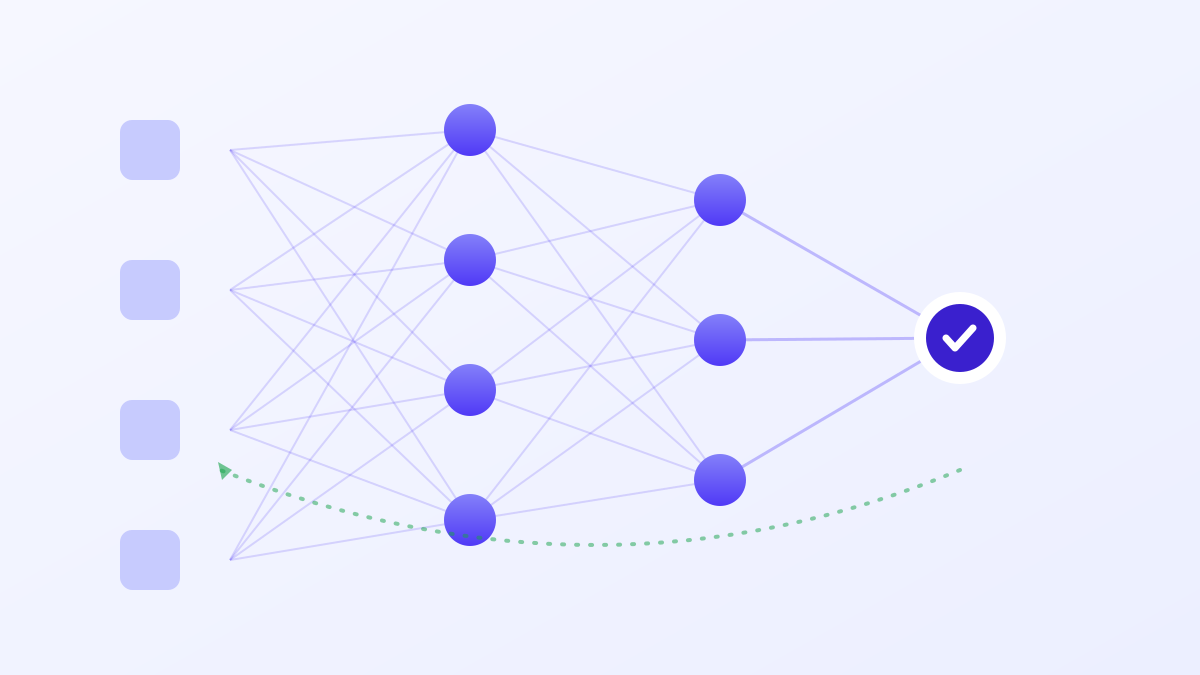
The "learning" is really just repeated small corrections. Nothing about it is magic, though the scale can be enormous: today's largest models are trained on huge amounts of text and adjust billions of parameters.
AI vs traditional software
| Aspect | Traditional software | AI system |
|---|---|---|
| How behaviour is defined | A developer writes explicit rules | The system learns patterns from examples |
| Handling new cases | Only what the rules anticipated | Generalises to similar unseen cases |
| When something is wrong | Fix the rule | Add data or retrain |
| Output style | Exact and repeatable | Often a best guess with a confidence level |
| Good fit for | Clear, stable rules (tax calculation, sorting) | Fuzzy patterns (language, images, recommendations) |
Neither approach is better in general. A payroll system should be exact, predictable rules. Recognising handwriting from a photo is far easier to learn from examples than to describe with rules.
The main ideas you will hear about
Machine learning
Machine learning (ML) is the branch of AI focused on learning from data. Most of what people call "AI" today is machine learning. It includes simple methods that predict a number or a category, as well as more complex ones.
Deep learning
Deep learning uses neural networks with many layers stacked on top of each other. Each layer transforms the data a little, and the stack as a whole can learn very rich patterns, such as the shapes that make up a face or the grammar of a language. Deep learning is why speech recognition, image recognition, and translation improved so sharply over the last decade.
Generative AI
Generative AI creates new content: text, images, audio, video, or code. Instead of only classifying or predicting, it produces something. Large language models that write and summarise text, and image models that turn a description into a picture, are both generative AI. They work by learning the statistical patterns of their training data and then producing new samples that fit those patterns.
Natural language processing
Natural language processing (NLP) is AI applied to human language: understanding a question, translating a document, pulling key facts out of a contract, judging whether a review is positive, or holding a conversation. Modern NLP is dominated by large language models.
Computer vision
Computer vision is AI applied to images and video: detecting objects, reading text in a photo, checking a product for defects on a factory line, or helping a car understand the road. It powers everything from phone camera effects to medical image analysis.
Types of AI
People often sort AI into three levels of capability. Only the first exists today.
Narrow AI
Narrow AI is good at one specific task or a small set of related tasks. A translation model, a recommendation engine, a chess program, a fraud detector: each is narrow. It can be superhuman at its job and completely unable to do anything else. Every AI system in real use today is narrow AI.
General AI
General AI, sometimes called AGI, would match a capable human across the full range of intellectual tasks, learning new skills the way a person does. It does not exist. Experts disagree strongly about whether it is years or decades away, or whether current methods can get there at all.
Superintelligence
Superintelligence describes a hypothetical system far beyond human ability in essentially every domain, including scientific creativity and strategy. It is a topic of serious long-term safety research and philosophical debate, not a product you can use.
Where AI is used
AI in education
AI can give students practice questions matched to their level, explain a concept a second way when the first did not land, grade routine work, and flag learners who look like they are falling behind so a teacher can step in. Used well, it gives each student more personalised attention than a single teacher could provide alone.
AI in healthcare
AI helps radiologists spot findings in scans, triages messages by urgency, drafts visit notes so clinicians spend less time typing, and supports drug discovery by narrowing down promising chemical structures. It assists trained professionals; it does not replace medical judgement.
AI in software development
Developers use AI to autocomplete code, explain unfamiliar code, write tests, translate between languages, and draft documentation. It speeds up routine work and lowers the barrier to trying something new, while the developer stays responsible for design, correctness, and security.
AI in business
Common uses include customer support assistants, summarising long documents and meetings, drafting first versions of reports and emails, sorting and routing incoming requests, and forecasting demand so inventory and staffing match reality more closely.
AI in finance
Banks use AI to detect fraudulent transactions in real time, assess credit risk, monitor for suspicious activity, and process documents such as invoices and statements. Regulation here is strict, so explainability and human oversight matter a great deal.
AI in transportation
AI plans delivery routes, predicts when a machine or vehicle needs maintenance before it breaks, manages traffic signals, and powers the perception systems in driver-assistance features. Fully self-driving cars in all conditions remain a hard, unsolved problem.
AI in cybersecurity
Defenders use AI to spot unusual patterns that might signal an attack, sort through huge volumes of alerts, and speed up investigations. Attackers use similar tools, so this is an ongoing contest rather than a solved problem.
AI in daily life
Search results, maps and traffic estimates, photo organisation, voice assistants, autocorrect, streaming and shopping recommendations, and spam filtering are all AI. Most of it is invisible, which is a sign it is working.
Benefits of AI
- Scale. It can process millions of items at a consistent pace, day and night.
- Speed. Answers and predictions arrive in seconds.
- Pattern spotting. It finds signals in large, messy data that people would miss.
- Availability. A support assistant or tutor can be there at 2 a.m.
- Lower barriers. People can write code, analyse data, or produce a first draft with less specialist training than before.
- Freeing up time. Automating routine work lets people focus on judgement, relationships, and creativity.
Limitations of AI
- No real understanding. A model predicts likely outputs from patterns; it does not "know" facts the way a person does.
- Only as good as its data. Gaps or errors in the training data show up in the results.
- Struggles outside its training. Give it a situation unlike anything it has seen and results get unreliable.
- Hard to explain. Complex models can be difficult to interrogate, which is a problem in regulated fields.
- Confidently wrong. It can present a mistake in fluent, convincing language.
- Cost and energy. Training and running large models uses significant computing resources.
Risks of AI
Privacy
AI systems often need large amounts of data, some of it personal. Poor handling can expose sensitive information, and models can sometimes repeat details they saw during training. Good practice means collecting only what is needed, protecting it well, and being clear with people about how their data is used.
Bias
If historical data reflects unfair patterns, a model trained on it can learn and repeat those patterns, for example in hiring or lending. This is not the model choosing to be unfair; it is the model faithfully copying what it was shown. It has to be tested for and corrected deliberately.
Job transformation
AI will change many jobs more than it eliminates them outright. Routine, repetitive tasks are most exposed. Roles that lean on judgement, human contact, physical dexterity in varied settings, and responsibility for outcomes are more durable. The honest summary is that the mix of tasks in many jobs will shift, and people will need to keep learning.
AI hallucinations
A "hallucination" is when a generative model produces something fluent but false: a made-up citation, a wrong date, an invented function name. It happens because the model is generating plausible text, not looking up verified facts. Always check important outputs against a reliable source.
Responsible AI
Responsible AI is the practice of building and using these systems carefully. In practice it means:
- Being clear about what a system can and cannot do.
- Keeping a human in the loop for consequential decisions.
- Testing for bias and unfair outcomes before and after launch.
- Protecting data and respecting consent.
- Monitoring live systems, because performance drifts as the world changes.
- Giving people a way to question or appeal an automated decision.
The future of AI
Reasonable expectations for the next few years, without over-claiming:
- More assistants, better integrated. AI features will keep showing up inside the tools people already use.
- Multimodal by default. Systems that handle text, images, audio, and video together will become normal.
- Smaller, cheaper models. Efficient models that run on a laptop or phone will handle many everyday tasks.
- More regulation. Rules on transparency, data, and high-risk uses are being written around the world.
- Focus on reliability. The next wave of progress is as much about trust, accuracy, and safety as raw capability.
General AI, if it arrives, is not on a confirmed timetable. Plan for steady, useful improvement rather than a sudden leap.
How students can learn AI
You do not need a research degree to become productive with AI.
- Get comfortable with the basics of programming, ideally Python. You can practise directly in the CampusEduX compiler without installing anything.
- Learn a little statistics and linear algebra. Enough to understand averages, probability, and what a model is doing.
- Take one structured course end to end rather than jumping between tutorials.
- Build three small projects. A spam classifier, an image recogniser, and a text summariser will teach you the whole workflow.
- Learn to use AI tools well. Writing clear instructions, checking outputs, and knowing the limits is now a core skill by itself.
- Read about ethics and safety. Understanding bias, privacy, and evaluation makes you far more valuable than someone who only knows the code.
How developers can use AI
- In the editor: autocomplete, explaining code, generating tests, and refactoring suggestions.
- In the product: adding search, summarisation, classification, or a support assistant by calling a model through an API.
- For data work: cleaning and labelling data, drafting queries, and exploring datasets faster.
- Guardrails matter: validate model outputs, never send secrets to a third-party service without checking your policy, handle errors and rate limits, and measure quality with real examples rather than a good demo.
Career opportunities in AI
The field is broader than "machine learning researcher." Growing roles include:
- Machine learning engineer – builds and ships models into products.
- Data engineer – builds the pipelines that feed models clean, reliable data.
- Data scientist / analyst – frames problems, tests models, and communicates findings.
- AI product manager – decides what to build and defines success and safety criteria.
- MLOps engineer – keeps models running, monitored, and up to date in production.
- AI ethics and policy specialist – assesses risk, fairness, and compliance.
- Prompt and evaluation specialist – designs and tests how applications use large models.
Strong fundamentals in programming, data, and clear communication open the door to all of them.
Frequently Asked Questions
Is AI the same as machine learning?
Not quite. AI is the broad goal of building systems that act intelligently. Machine learning is the main technique used to get there today. Deep learning is a type of machine learning. So machine learning sits inside AI, and deep learning sits inside machine learning.
Will AI take my job?
It is more likely to change your job than remove it. Tasks that are routine and repetitive are most exposed. Work that depends on judgement, human relationships, hands-on problem solving, and accountability is harder to automate. The practical response is to learn to use AI tools well and keep building skills that complement them.
Do I need to be good at maths to work with AI?
To use AI tools and build applications on top of existing models, you need solid programming and a basic grasp of statistics. To design new model architectures or do research, you need much deeper maths. Most jobs are in the first category.
Why does AI sometimes give wrong answers so confidently?
Generative models produce text that is statistically likely, not text they have verified. When they lack the right information, they still produce a fluent, confident answer that may be wrong. This is why you should check important results against a trusted source.
Is AI conscious or self-aware?
No. Current systems have no awareness, feelings, or understanding. They are pattern-based software. They can produce text that sounds self-aware because that pattern exists in their training data, but nothing is experiencing anything.
How can I start learning AI for free?
Begin with Python in a browser-based compiler, follow one complete beginner course, and build a few small projects such as a text classifier. Learning to write clear instructions for AI tools and to check their output carefully will take you a long way on its own.
Conclusion
AI is not a single invention or a looming robot. It is a large, fast-moving set of techniques for learning patterns from data and turning them into useful predictions and content. It is already woven into search, healthcare, finance, education, and the apps on your phone, and it is genuinely helpful when used with clear eyes about its limits.
The sensible attitude is neither fear nor blind enthusiasm. Understand what these systems do and do not do, keep a human in charge of decisions that matter, protect people's data, and check important outputs. If you are a student or developer, the best move is simple: start using the tools, build a few small things, and keep learning. The people who thrive alongside AI will be the ones who understand it well enough to direct it.